Research Topics
INTERIOR ARCHITECTURE 1st YEAR STUDIO
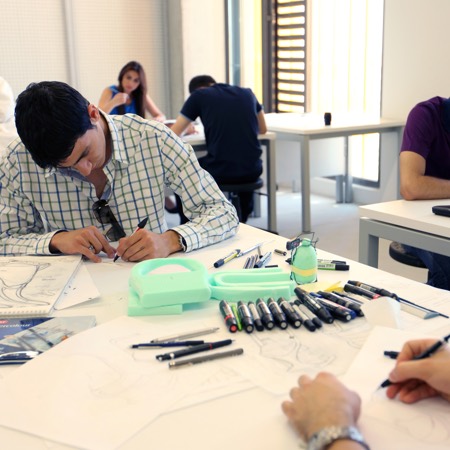
The fundamental design skills, creative thinking processes, and spatial perception that should be acquired by students in first-year interior architecture studios are addressed in this research area. Studies conducted on basic design education, material use, sensory experiences, and spatial compositions are evaluated under this heading.
Related Courses
İÇT121 Basic Design Education I
İÇT122 Basic Design Education II
İÇT128 Freehand Drawing Techniques
Researchers
Şaha Arslan
Publications
Aslan, Ş. (2020). From objects of sensation to objects of thought: Construction of the space and the text. XXIII. Generative Art Conference - GA2020.
Aslan, Ş., & Kızıltepe, F. (2018). The senses in basic design education. XXI. Generative Art Conference.
Aslan, Ş., & Kızıltepe, F. (2018). Design of the senses. XXI. Generative Art Congress.
Aslan, Ş. (2018). A concept development experience in the basic design studio: Weaving the concept, touching the concept. MSGSÜ 6th International Interior Architecture Symposium, 72–88.
Aslan, Ş. (2018). The construction of space as a problem of technology and ideology: From the emotion of space to the space of emotion. 3rd Art and Design Education Symposium.
Çelik, M. M., & Aslan, Ş. (2012). The basic design education course in spatial design education and an approach to the traceability of the course. İçMEK Interior Architecture Education 2nd National Congress.
SPATIAL DESIGN EDUCATION
Educational methodologies for spatial design, interdisciplinary approaches, and the digitalization of design education are addressed under this heading. Research shaped through interdisciplinary design approaches and design education is conducted. The development of experimental and practice-based learning processes in interior architecture education is examined.
Related Courses
İÇT121 Basic Design Education I
İÇT122 Basic Design Education II
İÇT123 Introduction to Spatial Design
İÇT124 Space Culture
İÇT221 Spatial Design Studio I
İÇT222 Spatial Design Studio II
İÇT331 Spatial Design Studio III
İÇT332 Spatial Design Studio IV
Researchers
Meryem Yalçın
Esin Fakıbaba Dedeoğlu
Şaha Aslan
Publications
Dedeoğlu, E., & Yalçın, M. (2022). Implications of digitalized interior architectural distance education. Journal of Pharmaceutical Negative Results, 13(Special Issue 10), 5085–5091.
Aslan, Ş., & Kızıltepe, F. (2020). Changing paradigms of the Bauhaus school: Rethinking design education. In A. D. İnan & A. Cengizkan (Eds.), BAUHAUS_100TR (pp. X–X). TED University, Faculty of Architecture Publications. ISBN: 978-605-80942-1-5.
Dedeoğlu, E., & Yalçın, M. (2020). Collaboration and scope areas of changing co-design approaches in the formation of design criteria. Journal of Wood Industry and Engineering, 2(2), 80–90.
Özdamar, B. B., & Yalçın, M. (2019). Integration of interior architecture education with innovative design approaches. In History, Development and Future of Interior Architecture Education in Turkey (pp. 312–327). ITU.
Yalçın, M., & Bozdayı, A. M. (2018). Successive and constructive design education as source of sustainable creativity: Gap between preschool and undergraduate design education. Journal of Modern Education Review, 8(4), 314–321.
Aslan, Ş. (2016). From 1914 to 2014: 100th year in the education of German and Turkish interior architecture. In P. Yıldız (Ed.), 1st International Symposium Education in Interior Architecture in the Year of German Turkish Research Education and Innovation (pp. X–X). Cambridge Scholars Publishing. ISBN: 978-1-4438-8940-7.
Aslan, Ş., & Savaş, S. (2015). An evaluation of the interdisciplinary structure of spatial design education from whole to part and from part to whole. MSGSÜ Faculty of Architecture Department of Interior Architecture 4th National Interior Architecture Symposium, 1(4), 287–297.
Yalçın, M. (2015). Progressive development of creative design skills from kindergarten education. Journal of Formakademisk, 8(1), 1–11.
Yalçın, M. (2015). “Exploratory” and “descriptive” aspects of environmental psychology course within the interior design education. Journal of Behavioral Science, 174, 3531–3541.
Yalçın, M. (2013). Consecutive cultural variables in relation of design problem: “Definition” and “solution”. 6th International Students Triennial, Marmara University, İstanbul, 3–7 June 2013.
HISTORY OF SPATIAL DESIGN
Related Courses
İÇT227 History of Spatial Design I
İÇT228 History of Spatial Design II
İÇT317 Surveying and Restoration
Researchers
Şaha Aslan
Gülşah Şenocak
Esin Fakıbaba Dedeoğlu
Publications
Şenocak, G. (2024). Semiotic analysis of mosque typology: The example of the TBMM mosque. IDA: International Design and Art Journal, 6(1), 54–70.
Şenocak, G. (2019). A rationalist–purist architectural trace in Ankara: Anafartalar Bazaar. 4th International Scientific Research Congress, 219–232.
Fakıbaba Dedeoğlu, E. (2018). Analyses of interior space interventions in repurposed church buildings. Journal of Art and Design, 23, 77–103.
Şenocak, G. (2018). A conservation process of cultural heritage: Ankara Saraçoğlu Quarter. International Congress on Sustainability in Architecture, Planning, and Design, 698–702.
Özdamar, M., Fakıbaba Dedeoğlu, E., Karaoğlu, Ö., & Moazemi, S. (2017). Different design decisions integrated in a single building: “Salt Galata.” Hacettepe University Journal of Art Writings, 36, 59–76.
Özdamar, M., Karaoğlu, Ö., Fakıbaba Dedeoğlu, E., & Moazemi, S. (2017). Usage problems in interior spatial connectivity in repurposed industrial buildings. Başkent University IMAS – Interior Architecture Research Symposium, Ankara.
Saraf Yıldızoğlu, M., & Aslan, Ş. (2010). Seating culture in the Ottoman Empire: Ottoman palace furniture in the transition from Topkapı Palace to Dolmabahçe Palace in the 19th century. MSGSÜ Faculty of Architecture, Department of Interior Architecture, 2nd National Interior Architecture Symposium, 1, 137–146.
SPACE-MATERIAL RELATIONSHIP
Related Courses
İÇT223 Structure and Material in Space
Researchers
Şükran Büşra Ümütlü
Ahmet Fatih Karakaya
Publications
Ümütlü, Ş. B., & Sayıl Onaran, B. (2024). On experience-oriented material learning in interior architecture education. PLANARCH - Design and Planning Research, 8(2), 250–259. https://doi.org/10.54864/planarch.1494201
Yıldırım, K., Karakaya, A. F., & Serdaroğlu, Z. (2024). The effect of wooden floor coverings used in offices on users’ perceptual evaluations. ISPEC International Journal of Social Sciences and Humanities, 8(4), 52–69. https://doi.org/10.5281/zenodo.14504695
Huyugüzel, B., Yıldırım, K., & Karakaya, A. F. (2023). A study on organic chemicals found in children’s room furniture. Gazi University Journal of Science Part C: Design and Technology, 11(3), 706–718. https://doi.org/10.29109/gujsc.1312640
Ümütlü, Ş. B. (2021). Smart materials and systems in the context of urban furniture: An example of designer and user experience. Interior Architecture Graduate Studies Symposium-III, 384–391.
Ümütlü, Ş. B. (2019). An examination of the usability of smart materials in spatial design. 4th International Scientific Research Congress, 309.
GLOBAL PERSPECTIVES TO DESIGN
Research and studies are conducted on the impact of our discipline—whose aim is to improve quality of life—in the field of humanitarian aid, and on structuring spatial design to create environments that are usable for everyone and transferable to the future. Research and studies focused on creating spaces that enhance quality of life in public space are listed.
Related Courses
İÇT408 Specialized Spatial Design Studio
İÇT409 Sustainable Design
Researchers
Gülşah Şenocak
Esin Fakıbaba Dedeoğlu
Şükran Büşra Ümütlü
Publications
Şenocak, G., & Sayıl Onaran, B. (2023). Interior architecture in humanitarian sheltering: Examples of “Shelter Projects.” Çukurova University Journal of the Institute of Social Sciences, 32(3), 246–264. https://doi.org/10.35379/cusosbil.1397236
Şenocak, G. (2021). Design criteria in refugee camps in Türkiye: Adana Sarıçam Accommodation Center. Sanat Yazıları, 44, 343–367.
Şenocak, G. (2021). Temporary disaster shelters in the context of individuals with special needs and a proposal for the design process. 5th National Building Congress and Exhibition, 107–123.
Sayıl Onaran, B., & Ümütlü, Ş. B. (2021). Post-COVID-19 era: Re-designing the work-life relationship through smart spaces and equipment. 2nd Contact Points Symposium / 2021, Nagoya City University.
Şenocak, G. (2020). Spatial analysis of Sarıçam Camp as an example of temporary housing design in refugee camps in Türkiye. İÇLİS III / Interior Architecture Graduate Studies Symposium-III, 631–639.
Fakıbaba Dedeoğlu, E. (2018). Public space quality in slow cities. Hacettepe University Journal of Art Writings, 41, 451–477.
Moazemi, S., & Fakıbaba Dedeoğlu, E. (2018). The relation between cultural identity of urban fabric and public spaces on the topic of slow city (Cittaslow). ISUFitaly 2018 4th International Congress: Reading Built Spaces. Cities in the Making and Future Urban Form, Bari, Italy.
Ümütlü, Ş. B. (2018). User perception and orientation in the museum designed by re-functioning: The example of Erimtan Archaeology and Art Museum. Beyond All Limits / 2018, 1, 747–750.
Fakıbaba Dedeoğlu, E. (2014). The process of Halfeti’s participation in the slow city (Cittaslow) movement and its aftermath. In B. Sayıl Onaran (Ed.), Evaluation of Urfa Halfeti as a Sustainable Urban Model in the Context of the Slow City (Cittaslow) Movement (pp. 65–87). Ankara: Emek Ofset. ISBN: 978-605-65308-0-7.
SPACE AND CONTEMPORARY CULTURAL STUDIES
The relationships between urbanization, spatial identity, and social dynamics are examined under this heading. Research is conducted on the sociocultural effects of public space, user experiences, urban aesthetics, and local–global spatial dynamics. The effects of cultural heritage on spatial design are also addressed within this scope.
Researchers
Meryem Yalçın
Ahmet Fatih Karakaya
Publications
Acar, A., Atalay Satağlu, F. B., Say, S., Tunca, M., Çetin, M. C., Çalışkan, Ş., Aydın Altay, S., Gürol Öngören, P., & Karakaya, A. F. (2022). Research and development of a geographically location-based mobile augmented reality technology application for cultural heritage. Journal of the Faculty of Engineering and Architecture of Gazi University, 37(4), 1931–1944.
Bilge, B., & Yalçın, M. (2020). Interior spatial features as a marketing issue. In Academic Studies in Social Sciences (pp. 292–301). IVPE Publications. ISBN: 978-9940-046-009-9.
Yalçın, M. (2018). Biomimetic material in the dimensions of interior spatial design. 6th International Interior Architectural Symposium, 14–16 November, Mimar Sinan Fine Arts University.
Yalçın, M. (2015). Methods of utilizing solar energy and daylight and the effects of these applications in interior spaces. 1st National Council of Interior Design, 12–14 September, Karadeniz Technical University, 175–184.
Yalçın, M. (2014). Psycho-social determinants in the formation of dining places within urban identity. Journal of the Faculty of Science and Letters, “City” Special Issue (2011/1–2), Maltepe University, 171–189.
Yalçın, M. (2014). Globalization and urban housing projects in relation to contemporary culture. Journal of the Faculty of Science and Letters, “Globalization” Special Issue (2012/1–2), Maltepe University, 23–42.
Çağatay, K., Yalçın, M., & Yıldırım, K. (2014). Spatial quality effects of students’ dormitory quality on users’ functional and perceptual performance: The sample of Tahsin Banguoğlu Student Dormitory. Journal of Design and Theory (Tasarım ve Kuram Dergisi), 18, 53–72.
Yalçın, M. (2013). Socio-cultural and physical determinants in the process of dining spaces. Journal of Art and Design (Sanat ve Tasarım Dergisi), 12, 173–191.
Yalçın, M. (2013). Consecutive cultural variables in relation to the design problem: “Definition” and “Solution”. 6th International Students Triennial, 3–7 June, Marmara University, İstanbul.
PHYSICAL CONTROL SYSTEMS IN SPACE
Researchers
Meryem Yalçın
Esin Fakıbaba Dedeoğlu
Kıvanç Kitapçı
Publications
Fakıbaba Dedeoğlu, E., & Yalçın, M. (2025). A proposal for the improvement of daylight integration and distribution in the educational interior space through a (Pro-Sun) ceiling design with curved surfaces. Sustainability, 17(3), 1096. https://doi.org/10.3390/su17031096
Zinah Al-Bayyar, Papatya Nur Dökmeci Yörükoğlu, Kitapci, K., & Türker Bayrak, Ö. (2025). Impact of indoor soundscape workshop on sound awareness of interior architecture students. J. Acoust. Soc. Am., 157(2), 1202–1214. https://doi.org/10.1121/10.0035569
Alkan, A. L., Yörükoğlu, P. N. D., & Kitapcı, K. (2023). Indoor soundscapes of the future: Listening to smart houses. In K. Güler (Ed.), Transforming Issues in Housing Design (1st ed., pp. 245–254). Wiley.
Kitapcı, K. (2023). Sound–noise control and music design in restaurants. In P. Şenel (Ed.), Restaurant Design (1st ed., pp. 102–124). Detay Publishing.
Alkan, A., Yörükoğlu, P. N. D., & Kitapci, K. (2023). An investigation of sound sources in smart houses for improved machine-to-human communication. Forum Acusticum 2023, Torino, Italy.
Al-Bayyar, Z., & Kitapci, K. (2022). Effects of reverberation time and sound source composition on sense of place constructs. Applied Acoustics, 185.
Kitapcı, K., & Çelik Başok, G. (2021). The acoustic characterization of worship ambiance and speech intelligibility in wooden hypostyle structures: The case of the Aslanhane Mosque. Acoustics Australia. https://doi.org/10.1007/s40857-021-00238-1
Kitapcı, K., & Akbay, S. (2021). Audio-visual interactions and the influence of colour on noise annoyance evaluations. Acoustics Australia. https://doi.org/10.1007/s40857-021-00220-x
Kitapcı, K., & Özdemir, D. (2021). Categorization of urban sound sources: A taxonomical framework based on diegesis and intention. Euronoise 2021, 1050–1059.
Kitapcı, K., & Özdemir, D. (2021). An interdisciplinary sound classification framework for environmental sound design. Inter-Noise 2021, International Congress and Exposition of Noise Control Engineering, 12, 1130–1141.
Kitapcı, K., & Dökmeci Yörükoğlu, P. N. (2021). Addressing sound as a design element in interior architecture education: The auditory landscape workshop experience. 14th National Acoustics Congress and Exhibition, 1, 82–90.
Kitapcı, K., & Al-Bayyar, Z. (2020). A room acoustics evaluation framework based on the sense of place constructs. Forum Acusticum 2020, 1753–1761.
Bilge, B., & Yalçın, M. (2020). Interior spatial features as a marketing issue. In Academic Studies in Social Sciences (pp. 292–301). IVPE Publications. ISBN: 978-9940-046-009-9.
Kitapcı, K., & Galbrun, L. (2019). Perceptual analysis of the speech intelligibility and soundscape of multilingual environments. Applied Acoustics, 151, 124–136. https://doi.org/10.1016/j.apacoust.2019.03.001
Kitapcı, K. (2019). Room acoustics education in interior architecture programs: A course structure proposal. INTER-NOISE 2019 MADRID – 48th International Congress and Exhibition on Noise Control Engineering.
Kitapcı, K. (2018). Acoustics and speech privacy in open-plan offices: A case study on computer-based task performance. GRID – Journal of Architecture, Planning and Design, 1, 1–23. http://dergipark.gov.tr/grid/issue/34270/357207
Galbrun, L., & Kitapci, K. (2016). Speech intelligibility of English, Polish, Arabic and Mandarin under different room acoustic conditions. Applied Acoustics, 114, 79–91. https://doi.org/10.1016/j.apacoust.2016.07.003
Galbrun, L., & Kitapci, K. (2014). Accuracy of speech transmission index predictions based on the reverberation time and signal-to-noise ratio. Applied Acoustics, 81, 1–14. https://doi.org/10.1016/j.apacoust.2014.02.001
Kitapcı, K., & Galbrun, L. (2014). Comparison of speech intelligibility between English, Polish, Arabic and Mandarin. Proceedings of Forum Acusticum 2014-Janua.
Kitapcı, K., Galbrun, L., O’Rourke, B., & Turner, G. H. (2013). Speech intelligibility in multilingual spaces. 42nd International Congress and Exposition on Noise Control Engineering 2013, INTER-NOISE 2013: Noise Control for Quality of Life, 3, 2023–2029.
Kitapcı, K., Yilmazer, S., & Erkip, F. (2007). Effect of speech intelligibility on visual short-term memory performance. Turkish Acoustical Society – 36th International Congress and Exhibition on Noise Control Engineering, INTER-NOISE 2007 ISTANBUL, 5, 3594–3604.
DESIGN EDUCATION AND DIGITAL ENVIRONMENTS
This heading addresses the integration of digital technologies and collaborative platforms into design education. Topics such as web-based education systems, extended and mixed reality (XR/MR) technologies, digital environments that support creative collaboration, and hybrid education models are emphasized. In particular, it examines how interdisciplinary learning processes can be supported through digital tools and what kind of digital infrastructure design students need to enhance their creativity. These studies contribute to the development of new approaches in education by offering projections on how design studios may be shaped in the future.
Related Courses
İÇT125 Presentation Techniques I
İÇT126 Presentation Techniques II
İÇT225 Computer-Aided Design I
İÇT226 Computer-Aided Design II
İÇT325 Computer-Aided Design III
İÇT320 Structure and Material
TSR505 Virtual Applications in Interior Space
TSR508 Specialized Interior Space Design Studio
Researchers
Ahmet Fatih Karakaya
Publications
Karakaya, A. F. (2024). Interdisciplinary physics teaching. In Ş. A. İlhan & M. A. Kireçci (Eds.), A design-oriented approach in physics education (pp. X–X). Economic Cooperation Organization Education Institute Publications. ISBN: 978-626-98870-2-9.
Karakaya, A. F., & Çorluluoğlu, G. (2023). Investigating a new learning environment for migrant students through art and technology. InSEA World Congress 2023, 34.
Karakaya, A. F., & Ada, C. (2023). Adapting new technological approaches to sustainable art education using blockchain and NFT. InSEA World Congress 2023, 76.
Karakaya, A. F., & Çorluluoğlu, G. (2023). A study into the scale perception levels of freshmen design students in interior architecture education. The Paris Conference on Education, 52.
Karakaya, A. F., & Ada, C. (2023). Objective design process evaluation at the jury stage in interior architecture education. In K. Günçe (Ed.), Interior Architectural Issues: Design, History, Education (pp. X–X). Livre de Lion Publishing House. ISBN: 978-2-38236-554-0.
Şahin Çağlı, Z., & Karakaya, A. F. (2023). Investigation of blockchain technology in education and development of distributed ledger models for sustainable design education. In H. Özyürek & Z. Baysal (Eds.), The Blockchain World (pp. X–X). NOBEL Scientific Publishing. ISBN: 978-625-398-448-9.
Karakaya, A. F., Ada, C., Güler, H., & Işkın, R. (2023). Determining design criteria on university campuses for sustainable development goals. 5th International Symposium on Art and Design Education: Sustainability in Art and Design, 562–573.
Çorluluoğlu, G., & Karakaya, A. F. (2022). On the interaction between shared design studios and interior architecture students: A new spatial experience with extended reality for supporting place attachment. Journal of Design Studio, 4(2), 75–86. https://doi.org/10.46474/jds.1149634
Çorluluoğlu, G., & Karakaya, A. F. (2022). On the interaction between shared design studios and interior architecture students: Proposing a new spatial experience with extended reality for supporting place attachment. 5th International Congress on Interior Architecture Education, 29–30.
Yazıcı, H., Şahin, E., & Karakaya, A. F. (2021). Collaborative experience in distance education with design thinking and extended reality. Mimarlıkta Sayısal Tasarım XV National Symposium, 375–386.
Karakaya, A. F., Yazıcı, H., & Özgündoğdu, A. F. (2019). Art and design students’ approaches to technology: Mixed reality practices in higher education. European Conference on Educational Research (ECER 2019), 141.
Karakaya, A. F. (2017). Use of mixed reality in design studio to enhance creativity of design students. The International Conference on Education and New Developments, 38–39.
Karakaya, A. F., & Demirkan, H. (2015). Collaborative digital environments to enhance the creativity of designers. Computers in Human Behavior, 42, 176–186.
Şenyapılı Özcan, B., & Karakaya, A. F. (2009). The future setting of the design studio. Open House International, 34(1), 104–112.
Karakaya, A. F., & Şenyapılı Özcan, B. (2008). Rehearsal of professional practice: Impacts of web-based collaborative learning on the future encounter of different disciplines. International Journal of Technology and Design Education, 18(1), 101–117.
Karakaya, A. F., & Taşlı Pektaş, Ş. (2007). A framework for web-based education systems supporting interdisciplinary design collaboration. METU Journal of the Faculty of Architecture, 24(2), 137–148.
Şenyapılı Özcan, B., & Karakaya, A. F. (2006). Hybrid framework for collaboration in design curricula. Joint International Conference on Construction Culture, Innovation and Management, 128–137.
Karakaya, A. F., & Şenyapılı Özcan, B. (2005). Design studio communication: Young generation holding on to old techniques. 3rd International Conference on Innovation in Architecture, Engineering and Construction (AEC), 375–385.
HUMAN AND SPACE
Related Courses
İÇT327 Environmental Psychology
Researchers
Meryem Yalçın
Publications
Yalçın, M., & Özdamar, B. B. (2021). Spatial analysis of the effects of single- and double-bed layouts on patients’ communication patterns and psychological states in dialysis centers. Journal of Megaron, 16(1), 157–167.
Çakıcıoğlu, F., & Yalçın, M. (2020). Effects of environmental graphic design issues as a supportive source of hospital spatial perception. International Refereed Journal of Design and Architecture, 21, 1–21.
Yalçın, M., & Çakıcıoğlu, F. (2020). Healing environments’ design properties affecting patients’ physio-social states. In Current Studies in Social Sciences (pp. 221–233). Academician Publications. ISBN: 978-605-258-892-2.
Yalçın, M. (2020). Supporting effects of spatial design in the physical therapy of cerebral palsy patients’ treatment centers. In Current Studies in Social Sciences (pp. 129–146). Academician Publications. ISBN: 978-605-258-174-924-3.
Yalçın, M., & Bozdayı, A. M. (2018). Successive and constructive design education as source of sustainable creativity: Gap between preschool and undergraduate design education. Journal of Modern Education Review, 8(4), 314–321.
Yalçın, M. (2018). Relationship of the Montessori approach with interior spaces in preschools and physical set-up. Journal of Megaron, 13(3), 451–458.
Yalçın, M., Bozdayı, A. M., & Ertek, M. H. (2017). Cultural determinants within the design setup of kindergarten and preschool interiors: Assessment of four typologies in terms of their spatial formation. Journal of Megaron, 12(1), 130–144.
Yalçın, M., Yıldırım, K., & Bozdayı, A. M. (2015). Developmental implications of children’s bedrooms in the interior environment and implementations of adults’ preferences. Journal of Megaron, 10(3), 305–316.
Yıldırım, K., & Yalçın, M. (2016). An exploratory and comparative evaluation of the spatial perception of two densities of multi-occupancy hospital rooms. Health Environments Research & Design Journal, 9(2), 212–227.
Yalçın, M. (2016). Global urban space: Child–urban relationship. In Proceedings of the 2nd International Urban Research Congress (pp. 820–834). İstanbul Technical University.
Yalçın, M., & Kök, T. (2016). Structured environment, spatial stimulation, and experience in child development. In Proceedings of the 5th International Interior Architectural Symposium (pp. 73–85). Mimar Sinan Fine Arts University.
Yalçın, M. (2012). Preschool education, formation, and historical development process of “kindergarten architecture”. Journal of Art Writings (Sanat Yazıları Dergisi), 27, 133–152.
Yalçın, M. (2012). Color perception of young children in preschool interior design. In Proceedings of the VIII Conference of Gruppo del Colore – Associazione Italiana Colore (pp. 257–263). Bologna, Italy.
Yalçın, M. (2013). Preschool institutional interior space/furniture quality, formation, and interaction. In Proceedings of the II National Furniture Congress (pp. 349–358). Pamukkale University.