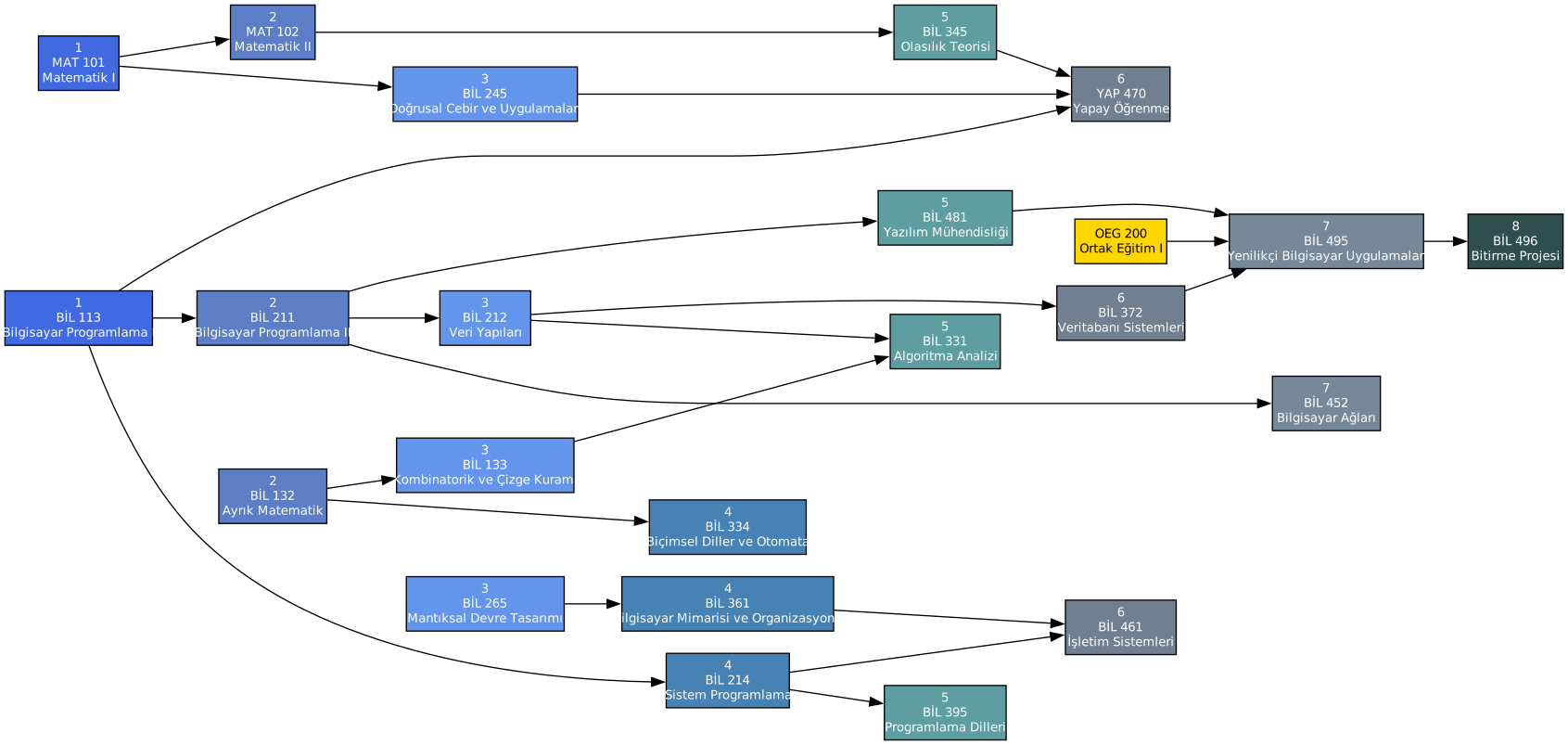
Departmental Required Courses
| Corse Code | Course Title | Prerequisite | Credits |
| YAP 191 | Critical Thinking | - | 3 Credits |
| Who are you, what is critical thinking, what is truth, what does it mean to know, how good are your ideas, the basic problem is “mine is better”, resistance to change, conformity, face-saving, stereotypes, oversimplification, hasty conclusions, unfounded assumptions, logical fallacies, combination of problems, self-awareness, being observant, clarifying problems, doing research, interpreting evidence, analyzing perspectives, making judgments, biases, fallacies, cognitive distortions | |||
| BİL 113 | Computer Programming I | - | 4 Credits |
| Introduction to programming. Compilers and interpreters. Fundamental elements and data types of programming language. Variables and assignment. Control Flow: Decision-Making and Loop Structures. Classes and Methods. Arrays and Array Lists. Inheritance and Recursion. | |||
| BİL 211 | Computer Programming II | BİL 113 | 4 Credits |
| This course covers some of the advanced features of the Java programming language. These features are generally found in most object-oriented programming languages. Topics include abstract and inner classes, global data types, the object model, and the graphical user interface. | |||
| BİL 132 | Discrete Mathematics for Computer Science | - | 3 Credits |
| Fundamentals of logic, propositional logic, first-order logic, logical inference, foundations of proof, set theory, foundations of induction and recursion, number theory, modular arithmetic, combinations and permutations, relations and functions. | |||
| BİL 133 | Combinatorics | BIL 132 | 3 Credits |
| Inductive and deductive inference methods. Defining propositional logic as a formal language and drawing conclusions. Defining first-order logic as a formal language and drawing conclusions. Recursive thinking and problem solving. Sums and recursive equations. Defining computational problems and introducing some abstract computational models. Fundamentals of algorithm analysis, asymptotic behavior of functions, common computation times. Sorting algorithms with quadratic time complexity and their analysis. Heap data structure and sorting using this data structure. Divide and conquer method and sorting algorithms using this method. | |||
| BİL 245 | Linear Algebra and its Applications | MAT 101 | 4 Credits |
| Introduction to vectors, length and inner product. Systems of linear equations and matrices, LU distinction. Graphs and networks, Laplacian matrix. Linear transformations, rotation operations, variation bases. Vector spaces, four principal spaces, independence and dimension. Projection, orthogonal spaces, Gram-Schmidt distinction. Determinant, volume, Cramer's rule, inverse matrices. Eigenvalues and eigenvectors, positive matrices, similar matrices, singular value distinction. | |||
| BİL 212 | Data Structures | BİL 211 | 4 Credits |
| This course covers data structures, the algorithms required to access and manipulate data held in these structures, and the techniques required to perform efficiency analyses of these algorithms. Topics: basic algorithm analysis, stacks, queues, linked lists, binary trees, binary search trees, priority queues (stacks), switching tables, and graphs. | |||
| BİL 264 | Logical Circuit Design | - | 3 Credits |
| Binary systems and codes. Boolean Algebra. Digital logic gates. Simplification of Boolean functions. Combinational logic. Synchronous sequential logic. Counters. Design problems. | |||
| BİL 264L | Logical Circuit Design Laboratory | - | 1 Credit |
| Reading integrated circuit catalog information and recognizing laboratory equipment. Implementation and simplification of Boolean functions using gate circuits. Function implementation with gates, combinational logic circuits (multiplexers and decoders). Flip-flops, shift registers and counters. Oscillator implementation. | |||
| BİL 265 | Logic Circuit Design and Applications | - | 4 Credits |
| Binary systems. Codes. Boolean Algebra. Digital Logic Gates. Simplification of their functions. Combinational Logic. Sequential Synchronous Logic. Counters. Design problems. Reading integrated circuit catalog information and getting to know laboratory equipment. Implementation and simplification of Boolean functions using gate circuits. Function implementation with gates, combinational logic circuits (multiplexers and decoders). Flip-flops, shift registers and counters. Oscillator implementation. | |||
| BİL 214 | System Programming | BİL 113 | 4 Credits |
| This course provides an introduction to programming in the Unix environment using the C language. The Unix kernel, shell, file system, and basic Unix commands. Unix utilities and Unix shell programming. The C programming language (functions, arrays, strings, pointers, dynamic memory allocation, low-level programming, and bit access). Unix system calls. Task control, signal trapping, and intertask communication. Editors, compilers, interpreters, converters, linkers, and loaders. | |||
| BİL 334 | Formal Languages and Automata | Prerequisite: BİL 132 | 3 Credits |
| Languages and their representations. Bounded automata. Abstract machines and the concepts of language acceptance. Deterministic and nondeterministic finite state machines. Context-free grammars. Pushdown automata. Turing machines and an introduction to the theory of computation. | |||
| BİL 345 | Probability Theory | Prerequisite: MAT 102 | 3 Credits |
| Counting and Combinatorics. Sample Space, Probability, Distribution and Random Variables. Discrete and Continuous Probability. Conditional and Independent Probability, Bayes' Rule. Multiple Random Variables. Expectation, Variance and Moments. Markov and Chebyshev Inequalities. Bernoulli and Poisson Processes. Gaussian Distribution. Limit Theories. | |||
| BİL 361 | Computer Architecture and Organization | Prerequisite: BİL 264 or BİL 265 | 3 Credits |
| Introduction to computer technologies. Performance comparison. Assembly programming language. Computer arithmetic. Processor implementation. Piping. Cache and virtual memory. Input/output structuring and interfacing. Multiprocessors. | |||
| BİL 331 | Algorithm Analysis | Prerequisite: BİL 133 or BİL 212 | 3 Credits |
| This course covers techniques for designing efficient algorithms, proving correctness of algorithms, and analyzing running times. Topics include: sorting and selection, algorithm design techniques (divide-and-conquer, greedy approximation, dynamic programming), graph algorithms (smallest spanning trees, shortest path algorithms, network flow), and NP-completeness. | |||
| BİL 395 | Programming Languages | Prerequisite: BİL 214 | 3 Credits |
| Classification of programming languages, language design, evolution of programming languages, syntax, semantics, lexical and syntax analysis, names, binding, type checking, scoping, data types, expression, expression-level control, subroutines, abstract data structures, functional programming languages, logic programming languages. | |||
| BİL 481 | Software Engineering | Prerequisite: BİL 211 | 3 Credits |
| This course covers basic theoretical and current practical information in the field of software engineering. Throughout the course, topics such as software design, development, understanding, testing, debugging, static analysis, coding guides, code inspection, version management, publishing, scaling, tracking, a/b testing, and code optimization are covered. Students are expected to contribute to large open source software projects in teams. The ability to systematically modify existing large software, which is expected from a software engineer today, will be tried to be gained through assignments and projects given to students. The main purpose of the course is to teach students how to build software that will have a long lifespan. | |||
| BİL 372 | Database Systems | Prerequisite: BİL 212 | 4 Credits |
| Database concepts. Data modeling with ER and ERR. Relational Data model. File structures and indexing. SQL language. Database design: functional dependency and table normalization. Database systems administration. Introduction to database programming. | |||
| BİL 461 | Operating Systems | Prerequisite: BİL 361 or BİL 214 | 3 Credits |
| Operating System Design Principles. Multi-user systems. Command interpreters. Semaphores. Deadlock detection, recovery, prevention, and avoidance. Multi-user operating systems. Processor management and algorithms. Memory management: segmentation, paging, segmentation, and thrashing. Device management: Interrupt handlers. Device drivers and controllers. Secondary memory management. File management. Data and program security and protection. Distributed system concepts. | |||
| BİL 452 | Data Communications and Computer Networks | Prerequisite: BİL 211 | 3 Credits |
| Introduction. Basic network components and concepts. OSI and TCP/IP Reference Models. Application Layer. Transport Layer and TCP/UDP protocols. Network Security. Network Layer and IP protocol. Data Link Layer. Media Access Middleware. Wireless Networks. Communication Fundamentals. Advanced Topics. | |||
| BİL 495 | Innovative Computer Applications | Prerequisite: BİL 481 and OEG 200 and BİL 372 | 1 Credit |
| Öğrenciler yenilikçi bilgisayar uygulamaları, başarı hikayeleri, girişimcilik fırsatları, gelecekte beklenen eğilimler konularında alanında uzman konuk konuşmacılarca bilgilendirilecek ve motive edilecektir. Öğrencilerden bir sonraki dönem yapacakları bitirme projesini tanımlamaları ve ilk aşamalarını (ihtiyaç analizi, kullanılacak teknolojilerin seçimi, kullanılacak veri setleri, araçlar, malzemeler vb. temini, genel sistem mimarisi, vb.) tamamlaması hedeflenmektedir. Giriş.İhtiyaç analizi.Beyin fırtınası ve fikirlerin belirlenmesi.Web teknolojileri.Mobil teknolojiler.Bulut teknolojileri.Sistem tasarımı.Proje yönetimi, iş paylaşımı ve takibi.Prototipleme.Kullanıcı deneyiminin ölçülmesi ve iyileştirilmesi. | |||
| BİL 496 | Graduation Project | Prerequisite: BİL 495 | 4 Credits |
| In this course, students conduct a research project. In this project, literature review, problem formulation and a comprehensive design are made for the solution of a computer engineering problem. The result of the design is presented to the project manager in the desired format at the end of the semester. Introduction. Planning. System Construction. Demonstration of Version 1 and planning of Version 2. System Construction. Demonstration of Version 3 and planning of Version 4. System Construction. Demonstration of Version 4 and planning of the final version. System Construction. Final demo. | |||
Elective Course Rules
Department students must take the following elective courses in addition to the compulsory courses specified in the curriculum.
| Course Type | Number | Credits | Rule |
| Departmental Elective | 5 | 3 | In the Computer Engineering undergraduate program opened by the Computer Engineering Department with the code BİL at the 300 and 400 level, all non-compulsory 3-credit courses can be counted as departmental electives. Apart from these courses, a maximum of 2 courses from the Departmental Elective Courses list can be selected as departmental electives. |
| Science Elective | 1 | 3 | A course from the Science Elective Courses list must be selected. |
| Faculty Elective | 1 | 3 | A course from the Faculty Elective Courses list must be selected. |
| University Elective | 1 | 3 | A course from the University Elective Courses list must be selected. |
Departmental Elective Courses with BİL Code
| Ders Kodu | Ders Adı | Önkoşul | Kredi |
| BİL 332 | Numerical Methods | BİL 245 | 3 |
| Approximate calculations. Truncation and rounding errors. Numerical solution of algebraic equations. Methods for solving systems of linear equations: Gauss Elimination method. LU decomposition and iterative methods. Matrix inverse computation. Interpolation: Lagrange, Newton, and Gauss formulas. Numerical integration: Trapezoidal, Simpson, and Romberg methods. Numerical solution of differential equations. | |||
| BİL 362 | Microprocessors | BİL 265 | 3 |
| Introduction to microprocessors. Addressing modes. Machine codes and assembly language programming. Subroutines, interrupts, and basic input/output. Serial and parallel communication. | |||
| BİL 401 | Introduction to Big Data | BİL 372 | 3 |
| Storage, indexing, access, and processing techniques for big data. The Map/Reduce algorithm and related technologies. Data analysis and applications within the big data ecosystem. This course covers the fundamentals of big data processing and analytics; it addresses the following questions: what is big data, how it differs from traditional data and conventional data processing, where it is used, and how it is used. | |||
| BİL 403 | Social Networks | BİL 133 ve BİL 211 | 3 |
| Within the scope of this course, the fundamental characteristics of social networks that represent relationships among individuals in society will be examined. In this context, relevant topics from graph theory literature will first be briefly reviewed, and selected network datasets will be introduced. Subsequently, concepts of social networks based on local properties—such as triadic closure, strong ties, weak ties, and passive participation—will be presented with reference to studies conducted on large-scale datasets. Next, the effects of concepts such as homophily, selection, social influence, and affiliation on the evolution of social networks will be discussed through studies based on large datasets. The notions of positive and negative relationships in social networks will be introduced with examples from the political science literature, and Harary’s balance theorem will be proved. In order to formally evaluate behavioral patterns of individuals in social networks, relevant parts of game theory and evolutionary game theory literature will be covered. Finally, the structure of information networks, link analysis, web search, and sponsored search markets will be examined. | |||
| BİL 404 | Algorithmic Game Theory | BİL 331 | 3 |
| Applications of selected classical games in the game theory literature (Prisoner’s Dilemma, Tragedy of the Commons, etc.) to computer networks. Definition of simultaneous and one-shot games and fundamental solution methods (dominant strategy solution, pure-strategy Nash equilibrium, mixed-strategy Nash equilibrium, correlated equilibrium, etc.). Solution methods for cooperative games. Computing the equilibrium of a simple market model using network flow algorithms. Nash’s theorem. The Vickrey auction. The time complexity of finding a Nash equilibrium. Efficient computation of Nash equilibria in two-player zero-sum games. The computational complexity of finding a correlated equilibrium. Network formation games and computing equilibrium inefficiency. Price of anarchy and price of stability. Local and global connection games. Potential games. Computing the price of stability in potential games via the potential function method. Nash equilibria in atomic and nonatomic routing games. Computing pure and mixed Nash equilibria in load-balancing games and their variants. | |||
| BİL 411 | Compilers | BİL 395 | 3 |
| Compilers and interpreters. Single-pass and two-pass language translators. Lexical analysis. Top-down parsing and LL(1) grammars. Recursive descent parsing. Bottom-up parsing. Shift-reduce technique. Operator-precedence grammar. LR(0) and SLR(1) grammars. Syntax-directed translation. Error handling and error recovery. Memory allocation. Static and dynamic allocation. Code generation. Optimization techniques in compilers. Scanner and parser generators. | |||
| BİL 412 | Internet Technologies | BİL 372 | 3 |
| Internet programming environments. Page design with HTML and DHTML. JavaScript. Web servers. CGI. SSI. SSL. Cookies. XML. Development of interactive Internet applications. | |||
| BİL 420 | Introduction to Cyber Security | BİL 214 | 3 |
| Overview of cybersecurity, current trends, attack and defense scenarios, risk analysis in information security, fundamentals of TCP/IP security, core security technologies and network architecture, operating system security, penetration testing methodologies and tools, web application security, fundamentals of network forensics, malware analysis, advanced persistent threats (APT), and fundamentals of exploit development. | |||
| BİL 421 | Computer Graphics | BİL 212 ve BİL 245 | 3 |
| This course is an introductory course covering the fundamental topics of computer graphics. It focuses on how various components such as algebra, geometry, algorithms and data structures, and optics interact in the creation of computer graphics. Topics include graphics systems, graphics programming, geometric programming and transformations, orthographic and perspective projections, lighting and shading, texture mapping, hidden surface elimination, and ray tracing. | |||
| BİL 422 | Human-Computer Interactions | BİL 212 | 3 |
| IBE approaches and history. Principle of usability. User-centered design. Human capabilities. Cognitive models. Predictive evaluation. Interpretive evaluation. Graphic design. User interface software. Pen-based systems and PDAs. Help and documentation. Speech. Non-speech audio. User interface agents. | |||
| BİL 423 | Cryptography | BİL 132 | 3 |
| Stream and block ciphers, DES, AES, modes of encryption, cryptanalysis methods, number theory, finite fields, public-key cryptography, RSA, factorization algorithms, elliptic curve cryptography, digital signatures, hash functions, and provable security. | |||
| BİL 424 | Game Programing | BİL 212 and BİL 245 | 3 |
| Game design process. Game design principles. Game architectures. 2D game engines. Graphics. Sprite extraction. Interactive scenarios. Rigid body modeling. Animation and collision detection. Timing and multithreading. Game artificial intelligence. Optimization techniques. Real-time simulations. Multiplayer games. | |||
| BİL 425 | Developing Software for Mobile Devices | BİL 211 | 3 |
| Application software development for mobile devices (smartphones and tablets) using new technologies. Software development for the Android platform. Using the software development environment and debugging. User interface development. Multithreading and network application development. Using sensors (GPS, camera, compass, accelerometer, touchscreen, etc.). | |||
| BİL 431 | Algorythm Practices | BİL 331 | 3 |
| Advanced data structures, efficient data structure design, advanced graph theory problems, advanced dynamic programming problems, advanced search techniques, combinatorics, problem-specific creative algorithm design, NP-hard problems, approximation and heuristic methods for hard problems, efficient implementation, elegant problem design for competitions, and problem solving in online contests. | |||
| BİL 435 | Computational Geometry | BİL 331 | 3 |
| This course is an introductory course on computational geometry and its applications. Computational geometry focuses on the algorithmic treatment of problems with geometric properties. | |||
| BİL 436 | Convergence Algorithms | BİL 331 | 3 |
| Lower bound techniques. Combinatorial approximation algorithms for the set cover, Steiner tree, TSP, multicut, k-cut, and k-center problems. FPTAS, PTAS, and asymptotic PTAS. Linear programming–based approximation algorithms. Randomized, deterministic, and iterative rounding techniques. Approximation of the Steiner forest problem using the primal–dual method. Semidefinite programming. The PCP theorem. | |||
| BİL 441-YAP 441 | Artificial Intelligence | BİL 212 and BİL 345 | 3 |
| Introduction, definitions, concepts, examples, and the historical development of artificial intelligence. Intelligent agents. Search methods for problem solving. Complex search, constraint optimization, and game playing. Machine learning and statistical learning. The concept of uncertainty and probabilistic problem solving. Classification and clustering methods. Fundamentals of artificial neural networks and genetic algorithms. Fuzzy logic, fuzzy modeling, fundamentals of expert systems, and decision trees. Propositional logic–based approaches to problem solving. Planning. Machine vision, natural language processing, and fundamentals of robotics. | |||
| BİL 442-YAP 442 | Deep Learning | BİL 470 | 3 |
| Study of artificial neural networks within machine learning that are based on the working model of the human brain, problem-dependent model development, and data analysis using artificial neural networks. | |||
| BİL 443 | Pattern Recognition | BİL 470 | 3 |
| This course provides the foundational background of pattern recognition, a subfield of artificial intelligence and data science that focuses on methods for mapping input data to output classes or values. The course covers approaches to classification, regression, and clustering problems, fundamentals of statistical learning, feature extraction, feature selection, and pattern recognition applications. | |||
| BİL 448 | Internet Security Protocols | BİL 132 and BİL 214 | 3 |
| Fundamental cryptographic primitives, symmetric key encryption, public key cryptography, digital signatures, certificates, secure key exchange protocols, the Internet and security, IPsec, SSL/TLS, DNSSEC, routing security, PGP, DKIM, SSH, Tor, and selected topics. | |||
| BİL 455 | Parallel Processing | BİL 214 | 3 |
| Parallel computer architectures. Parallel algorithm design. Message-passing–based programming. Shared-memory–based programming. Performance analysis. Matrix–vector multiplication. Load balancing. Heterogeneous architectures. | |||
| BİL 457 | Wireless Networks | BİL 452 | 3 |
| Fundamentals of wireless communication. Modulation. Multiple access methods. Wireless LANs. IEEE 802.11. Bluetooth. Wireless network layer. Ad hoc networks. Wireless TCP. Security of wireless networks. | |||
| BİL 462 | Biometric Recognition | BİL 470 or YAP 470 | 3 |
| Introduction to biometric systems. Design of biometric systems. Verification and identification. Performance analysis. Physiological traits: fingerprint, vein, face, iris, periocular region. Behavioral traits: keystroke dynamics, gait, signature, voice. Multimodal biometrics. Continuous biometric authentication. Biometric sample quality. Privacy and template protection. Presentation attacks. Standards. Applications. | |||
| BİL 465 | Advanced Computer Architecture | BİL 361 | 3 |
| Architectural-level techniques for low power consumption; the relationship between processor performance and power consumption. Reliability and dependability in microprocessors: transient and permanent faults. Data prefetching techniques for caches. Multi-cluster, multicore processors. Multithreading and speculative multithreading in processors. Virtual machines. Detection of program phases and the design of processors that adapt to these phases. Microarchitectural techniques for mitigating magnetic noise. Complexity issues in computers capable of processing a very large number of instructions simultaneously. Techniques that exploit the relationship between compilers and microprocessors. | |||
| BİL 466 | Embedded System Programing | BİL 214 and BİL 361 | 3 |
| Embedded processor architecture and programming. I/O and other device driver interfaces. Embedded processors with networking, video, and storage capabilities. Operating system primitives for concurrency, timeouts, scheduling, communication, and synchronization. Real-time resource management. Application-level embedded system design. | |||
| BİL 467 | Image Processing | BİL 211 and BİL 245 | 3 |
| Fundamental concepts of image processing, digital image processing operators, image enhancement and histograms, image filtering, image transformations, edge detection, morphological operators, image segmentation techniques, feature extraction from images, texture analysis, template matching, image analysis, and object detection. | |||
| BİL 468 | Computer Vision | BİL 470 or YAP 470 | 3 |
| Introduction to computer vision and its applications. Image formation. Geometric fundamentals and transformations. Basic image processing techniques. Image enhancement and filtering. Edge detection. Line detection and the Hough transform. Feature extraction and feature matching. Instance recognition. Introduction to machine learning. Deep artificial neural networks. | |||
| BİL 470-YAP 470 | Artificial Learning | BİL 113, BİL 245 and BİL 345 | 3 |
| Concept learning, linear regression, classification, resampling methods, linear model selection and regularization, decision trees, support vector machines, probabilistic models, artificial neural networks, unsupervised learning, learning theory, ensemble models, and reinforcement learning. | |||
| BİL 471 | Natural Language Processing | BİL 470 or YAP 470 | 3 |
| Regular expressions. Text normalization techniques. Computing edit distance between texts. N-gram language models. Part-of-speech tagging. Syntactic parsing of texts. Representation of word meanings. Semantic parsers. Information extraction. Word sense disambiguation. Sentiment classification. Word embeddings. Deep learning in natural language processing. Question answering. Emerging research topics in natural language processing. | |||
| YAP 471 | Computational Finance | 3 | |
| The aim of this course is to equip students with the principles of derivative pricing and numerical methods used to solve stochastic problems in finance. The course teaches the fundamental numerical techniques of finance, including lattice methods, finite difference methods, Monte Carlo simulation, and density transformation methods. After establishing the Black–Scholes option pricing framework, the course applies numerical methods to the pricing of derivative products such as plain and exotic options, real options, and credit-risky and risk-free bonds, as well as bond pricing problems. | |||
| BİL 472 | Information Access Systems | BİL 470 or YAP 470 | 3 |
| Introduction to Information Retrieval Systems: the concept of relevance. Vector Space Model and ranking functions. Representation of documents for search operations. Indexing. Evaluation of search result effectiveness. Search acceleration techniques. Relevance feedback methods. Language models. Learning-to-rank models. Text classification. Deep learning in information retrieval systems. Emerging information retrieval domains: social media. Emerging information retrieval domains: fact verification and event detection. | |||
| BİL 473 | Bioinformatics | BİL 470 or YAP 470 | 3 |
| Fundamentals of molecular biology. Biological databases. Sequence alignment, multiple sequence alignment, phylogeny, and evolution. DNA and next-generation sequencing. RNA, microarray, and RNA-seq data analysis. Proteomics and protein structure. Protein structure prediction. Functional genomics. Biological networks and systems biology. | |||
| BİL 476 | Data Mining | BİL 470 or YAP 470 | |
| Data warehousing and online analytical processing. Time series analysis. Data preprocessing. Analysis of data mining tasks. Clustering. Association analysis and rule mining. Classification and prediction. Sequential analysis. Data mining applications. | |||
| BİL 482 | Design Patterns | BİL 211 | 3 |
| Introduction to design patterns. Definition, benefits, and areas of use of design patterns. Bridge, Strategy, State, Decorator, Visitor, Interpreter, Observer, Mediator, Command, Abstract Factory, Factory, and Prototype design patterns. Pipe-and-filter, layered, and architectural patterns. Application of design patterns to software problems. | |||
| BİL 483 | Software Product Lines | BİL 211 | 3 |
| In order to extend the lifespan of software systems, reduce costs, and ensure desired software quality attributes, software companies are increasingly shifting from project-based processes to product-line–based processes. Accordingly, software requirements are defined not as fixed, project-based requirements, but with reference to continuously evolving product families defined as portfolios. This type of process affects all supporting activities, from software business models and architectural design to software implementation. Realizing a software product increasingly becomes the configuration of building blocks that are pre-coded or generated from models. The aim of this course is to understand and apply software product line processes. For this purpose, students will form project groups. Each project group will be assumed to be responsible for developing a software product line within a company. The course consists of the preparation of a project design report and an oral examination | |||
| BİL 486 | Introduction to Robotics | FİZ 101,BİL 211 and BİL 245 | 3 |
| What is a robot. From the first robots to modern systems, the components that constitute a robot. The relationship between artificial intelligence and robotics. Sensors and the characteristics of different types of sensors. Robot motion. Robot control, control algorithms, and control architectures. Perception of the robot’s environment. Sense–plan–act architecture, reactive control architectures, and motion planning. Localization, search, path planning, and SLAM. | |||
| BİL 488 | Combinatorial Algorithms | BİL 331 | 3 |
| Kombinatoriksel algoritmalar. Deterministic olmayan algoritmalar. P ve NP sınıfları. NP-hard ve NP-complete problemler. Hızlı kombinatoriksel algoritma dizaynı. Optimizasyon problemleri. Simplex algoritması. Dualite. Primal-Dual algoritması. Akış algoritmaları. Lineer programlama. | |||
| BİL 489 | Graph Theory | BİL 331 | 3 |
| Paths and search. Trees. Networks. Circuits. Planarity. Matching and independence. Connectivity. Coloring. Flow. | |||
| BİL 490 | Independent Research I | OEG 300,BSD 1, BSD 2 and GNO ≥ 2,50 | 3 |
| The student prepares, conducts, and reports a project on a selected research topic in accordance with scientific research methods. | |||
| BİL 491 | Independent Research II | BİL 490 | 3 Kredi |
| The student prepares, conducts, and reports a project on a selected research topic in accordance with scientific research methods. | |||
Departmental Elective Courses Offered by Other Departments
- ELE 371 Signals and Systems
- ELE 422 CMOS VLSI Design
- ELE 472 Information Theory
- ELE 473 Image Processing
- ELE 519 Embedded Systems
- END 321 Random Models
- END 294 Operational Research I
- END 395 Operational Research II
- END 507 Heuristic Search Methods
Science Elective Course List
- BMM 102 Biochemistry
- BMM 203 Medical Biology
- ELE 231 Electromagnetic Field Theory
- END 214 Probability and Statistics II
- END 321 Random Models
- KİM 101 General Chemistry
- MAK 201 Thermodynamics
- MAT 202 Differential Equations
- MBN 201 Materials Science I
Faculty Elective Courses
- BMM 202 Cells and Molecular Biology
- ELE 201 Circuit Analysis I
- ELE 301 Control Systems I
- ELE 371 Signals and Systems
- END 214 Probability and Statistics II
- END 294 Operational Research I
- END 321 Random Models
- END 507 Heuristic Search Methods
- MAK 104 Statics
- MAK 201 Thermodynamics
- MBN 201 Materials Science I
University Elective Courses
- EÜT 105 Product Visualization
- EÜT 211 Ergonomics in Product Design
- GİT 103 Pattern I
- GİT 309 3D Modelling
- HUK 115 Introduction to Law
- HUK 216 International Law (English)
- HUK 313 European Union Law (English)
- HUK 407 Labor Law
- HUK 439 Intellectual Property Rights
- HUK 441 Occupational Health and Safety
- İÇT 109 Freehand Drawing Techniques
- İÇT 112 Spatial Culture
- İDE 101 Survey of English Literature I
- İDE 105 Short Story
- İDE 108 Classic Mythology
- İKT 213 Microeconomic Theory I
- İKT 233 Macroeconomic Theory I
- İKT 351 Econometrics
- İŞL 253 General Accounting
- İŞL 361 Financial Management
- MAK 101 Computer-Aided Technical Drawing
- MİM 113 Architectural Culture, History, and Theories I
- PSİ 103 Introduction to Psychology I
- SAT 205 Photography I
- SUİ 101 History of Civilizations
- SUİ 102 Political History
- SUİ 105 Introduction to Political Science
- SUİ 108 Introduction to Sociology
- SUİ 114 Introduction to Global Politics
- SUİ 207 Political Theory
- SUİ 213 Turkish Foreign Policy
- TAR 113 Ancient History and Civilization
- TAR 131 Turkish History I
- TAR 223 Islamic History and Civilization I
- TAR 325 American History
- TDE 111 Ottoman Turkish I
- TDE 131 Introduction to Literature
- TDE 132 History of the Turkish Language
- TDE 143 Contemporary Turkish Literature I
- YAP 192 History of Science
- TDE 301 Semantics
- TDE 310 Syntax
Service Courses
| Course Code | Course Name | Prerequisite | Credit |
| BİL 141 | Computer Programing I | - | 4 |
| Introduction to structured programming, basic input–output statements, arithmetic expressions, variables, basic control flow statement (if), iteration (while loop), equality and other relational operators, iteration (for and do–while loops), use of library functions and function definition, function definition and simple recursion, arrays, pointers, user-defined data types (struct, enum, and union), file operations (text file input–output). | |||
| BİL 142 | Computer Programing II | BİL 141 | 4 |
| Introduction to object-oriented programming, object and class concepts, object and class definition, operator overloading, inheritance, polymorphism, function and class templates, exception handling, stream input/output. | |||
| BİL 121 | Introduction to Information Technologies | - | 3 |
| General features of Word, document creation in Word, use of tables and templates in Word, creating research papers and newsletters in Word, PowerPoint presentation formatting, creating animations in PowerPoint, use of video, tables, and charts, creating worksheets and chart data in Excel, using functions in Excel, creating tables, managing large workbooks, graphical data analysis in Excel, analysis tools, control and validation, creating a personal website using Weebly (free, online interface). | |||