Research Topics
Production and Service Systems Design and Planning
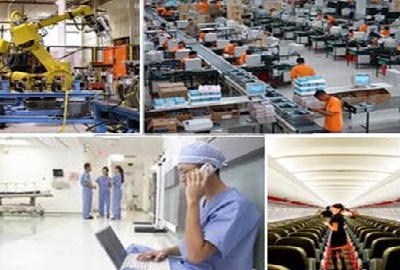
The design of production and service systems includes deciding on the product/service family to be produced, long-term demand forecasting, determining the materials, processes, and methods to be used, selecting machinery and equipment, and designing workflow, work systems, and facility layout. The planning problem involves forecasting incoming jobs or orders in an existing production or service system, prioritizing them, matching capacity with demand through capacity planning, and determining which jobs or orders will be processed, when, and in what quantities by existing production units.
Related Projects:
- Green Robotic Cell Scheduling, TÜBİTAK-1001, 2016–2018, Budget: 243,750 TL
- Control of the Ministry of National Education Budget and Monitoring Performance-Based School Education Performance, KAMAG Project, Ministry of National Education, 2009–2012, Budget: 1,400,000 TL
- Maximization of Production Rate in Flexible Flow Shop Systems: The Value of Flexibility, Mathematical Modeling and Solution Techniques, TÜBİTAK, 2011–2013, Budget: 121,530 TL
- Software Development Based on Mathematical Models for the Optimization of Safety Stocks and Order Lot Sizes, KOSGEB, 2011–2012, Budget: 158,400 TL
- Doç. Dr. Hakan Gültekin
- Doç. Dr. Kadir Ertoğral
- Doç. Dr. Nilgün Fescioğlu Ünver
- Dr. Öğr. Üyesi Kürşat Derinkuyu
- Dr. Öğr. Üyesi Salih Tekin
- END 520: İleri Üretim Sistemleri ve Stok Kontrol
- END 522: Kalite Mühendisliği
- END 524: Sıralama ve Çizelgeleme
Supply Chain Management and Logistics

Supply chain and logistics management is becoming increasingly important for gaining competitive advantage in a globalizing market. In this context, the use of analytical methods for the planning, design, and control of supply chain and logistics systems is gaining importance.
Related Projects:
- Route planning and cost allocation optimization in full truckload shipper collaboration, TÜBİTAK, 2012–2015, Budget: 168,860 TL
- Facility location and capacitated intermodal hub network design for main distribution centers, TÜBİTAK, 2012–2014, Budget: 139,970 TL
- Doç. Dr. Ayşegül Altın Kayhan
- Doç. Dr. Kadir Ertoğral
- Dr. Öğr. Üyesi Eda Yücel
- Dr. Öğr. Üyesi Gültekin Kuyzu
- END 411: Tedarik Zinciri Yönetimi
- END 426: Lojistik
- END 504: Şebeke Modelleri ve Optimizasyon
- END 540: Tedarik Zincirinde Analitik Modeller
Optimization

Many real-life problems can be formulated in this way and are successfully applied in numerous fields such as production, supply chain, logistics, engineering design, and finance. It requires an interdisciplinary approach and background that integrate multiple disciplines, including mathematics, computer science, and management science. The fundamental solution techniques include mathematical modeling and heuristic methods.
Related Projects:
- Energy-Efficient Wireless Sensor Network Design with Topology Control and Partial Redundancy-Based Reliability Measures, TÜBİTAK, 2013–2016, Budget: 84,000 TL
- Doç. Dr. Ayşegül Altın Kayhan
- Doç. Dr. Hakan Gültekin
- Doç. Dr. Kadir Ertoğral
- Dr. Öğr. Üyesi Eda Yücel
- Dr. Öğr. Üyesi Gültekin Kuyzu
- Dr. Öğr. Üyesi Kürşat Derinkuyu
- END 501: İleri Doğrusal Programlama
- END 502: Tamsayılı Programlama
- END 503: Doğrusal Olmayan Programlama
- END 507: Sezgisel Arama Yöntemleri
Stochastic Models and Decision Analysis

It is used in modeling and solving engineering problems involving uncertainty in the production and service sectors, and it can also be applied to economic, healthcare, public administration, and business problems where similar dynamics arise. The field of decision analysis examines individuals’ behavior in single- and multi-criteria decision problems, both by developing analytical models and through behavioral analysis.
Related Projects:
- Asymptotic Properties of Complex Stochastic Systems, TÜBİTAK, 2011–2014, Budget: 82,380 TL
- Analysis of the Value of Information and Risk Sensitivity Using Different Approaches, TÜBİTAK, 2011–2012, Budget: 12,000 TL
- Doç. Dr. Nilgün Fescioğlu Ünver
- Dr. Öğr. Üyesi Salih Tekin
- Prof. Dr. Tahir Khaniyev
- END 423: Karar Analizi
- END 521: İleri Sistem Benzetimi
- END 570: Stokastik Süreçler
- END 572: Markov ve Yenileme Süreçleri
Fuzzy Logic and Soft Computing

The difference between the Soft Computing approach and traditional computing methods is that it increases the robustness and manageability of solutions by tolerating uncertainty, partial correctness, and imprecision. Soft computing takes the operating principles of the human brain as its role model.
Related Projects:
- Type-1 and Full Type-2 Fuzzy System Models, NSERC (National Science and Engineering Research Council) – Discovery Grant, Canada, Year: 2011–2015, Budget: 300,000 TL
- Doç. Dr. Nilgün Fescioğlu Ünver
- Prof. Dr. Tahir Khaniyev
- END 450: Bulanık Küme ve Mantık Teorisi
- END 451: Bulanık Sistem Modelleri ve Uygulamaları
- END 552: Bulanık Olasılık
- END 641: Tip-2 Bulanık Sistem Modelleri