Research Topics
Particle Accelerators and Their Applications
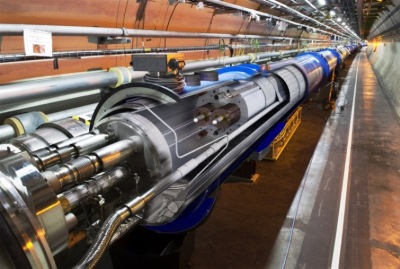
Particle accelerators are strategic high-technology systems that employ electric and magnetic fields to accelerate beams of charged particles. Possessing advanced infrastructure and a wide range of applications, these accelerators constitute a critical and productive technological domain. Ranging in scale from meters to kilometers, particle accelerators enable the production of beams at desired energies between the MeV and TeV ranges. With approximately 30,000 accelerators in operation worldwide, these systems occupy a pivotal role across a broad spectrum of applications—from probing the internal structure of matter to thorium-based nuclear reactors, and from materials science and nanotechnology to cancer therapy. Milestone achievements such as the Human Genome Project were made possible through the use of Synchrotron Radiation and Neutron Sources, while ion implantation has become an indispensable process in modern microelectronics. (See: S. Sultansoy, “Accelerator Technology for the Mankind,” http://arxiv.org/abs/physics/0611076.) The Accelerator Technologies Research Group at TOBB ETÜ contributes to both international (LHeC, CLIC, FCC) and national (TAC) projects. In addition, the Group is engaged in research activities aimed at establishing a MeV-scale electron accelerator at our university with CERN support and advancing Accelerator-Driven Thorium-Fueled Nuclear Power Plant technologies in Türkiye.
Related Projects:
Linac-LHC Based ep, γp, eA and γA Colliders, DPT-TAEK, 2008–2011
A Large Hadron electron Collider at CERN — http://lhec.web.cern.ch/
Compact Linear Collider (CLIC) — http://clic-study.web.cern.ch/
Future Circular Collider (FCC) — https://fcc.web.cern.ch/Pages/default.aspx
Turkic Accelerator Complex (TAC) — http://tac.en.ankara.edu.tr/
- Doç. Dr. Ali Bozbey
- Dr. Ahmet Nuri Akay
- Prof. Dr. Saleh Sultansoy
- MBN 313: Yüksek Enerji Fiziğine Giriş
- MNT 524: Hızlandırıcı Teknolojileri ve Uygulamaları
High Energy Physics
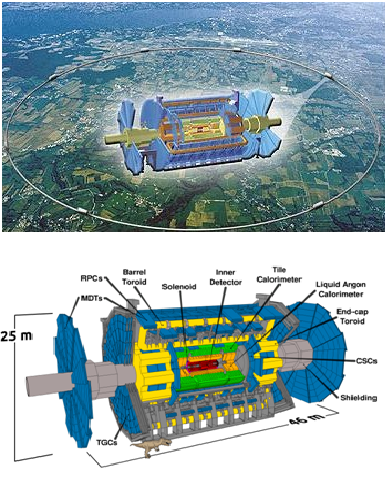
Humanity’s quest to understand the universe and its underlying principles continues today under the discipline known as High Energy Physics (HEP). The investigation of the fundamental constituents of matter and the forces that bind them has driven people to think more deeply, to ask new questions, and consequently, to develop new technologies. Since the foundations of modern science were laid by Rutherford’s experiment, the internal structure of the atom—referred to by Mehmet Akif Ersoy as “maddenin kudret-i zerriyesi” (the might of the particle of matter)—has been studied through the devoted efforts of countless scientists. Despite major achievements, numerous unresolved questions remain within High Energy Physics. Although the Standard Model is regarded as a successful theoretical framework for explaining the structure of matter, it still fails to address several fundamental issues. This has led researchers to explore theories beyond the Standard Model, such as Grand Unification, Supersymmetry (SUSY), preonic models, and theories involving extra space-time dimensions. Our HEP group predominantly conducts theoretical research on the possible new substructure of matter—namely, preons, the hypothetical constituents of quarks, leptons, and bosons. To test such theories, the world’s largest research center, CERN (the European Organization for Nuclear Research), hosts scientists and experiments capable of probing these concepts. TOBB ETÜ is a member of ATLAS, one of the two experiments at CERN that discovered the Higgs boson. Several new processes proposed by our HEP group have been incorporated into the ATLAS research program
Related Projects:
Search for a Possible New Substructure of Matter in TeV-Scale Colliders, TÜBİTAK 1001, 2015–2018
Data Acquisition, Data Analysis, Detector, Trigger, and Data Flow Operations and Upgrades in the CERN–ATLAS Experiment, Ministry of Development – TAEK, 2011–2016
ATLAS Experiment — http://atlas.ch/
Turkic Accelerator Complex — http://tac.en.ankara.edu.tr/
- Dr. Ahmet Nuri Akay
- Prof. Dr. Saleh Sultansoy
- MBN 313: Yüksek Enerji Fiziğine Giriş
- MNT 524: Hızlandırıcı Teknolojileri ve Uygulamaları
- MNT 540: Parçacık Detektörleri ve Uygulamaları
Proton Exchange Membrane Fuel Cells
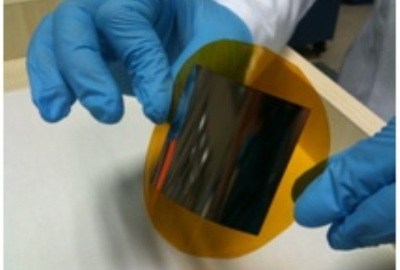
Among known alternative energy sources (such as solar and wind power), fuel cells possess a highly efficient power generation capacity and are envisioned as one of the most significant energy technologies of the near future. The fundamental principle of fuel cells is to generate energy without burning the fuel directly and without producing harmful gas emissions. Unlike conventional batteries used in everyday life, fuel cells continue to produce energy as long as fuel is supplied to the system. This energy can be used to power a vehicle or meet the energy needs of an entire residential area. At the TOBB ETÜ Energy Research Laboratory, Assoc. Prof. Dr. Mehmet Sankır and his team designed the first fuel cell in which all components were manufactured domestically. Prototype production efforts have also begun for integrating this fuel cell into unmanned aerial vehicles.
Related Projects:
Production of a Proton Exchange Membrane Fuel Cell Operating Between 1–5 kW and Its Use as a Power Unit, Ministry of Industry and Trade – SANTEZ, 2009–2012.
Development of a Cartridge System Producing High-Kinetics Hydrogen Gas from Chemical Hydrides for Electric Vehicles, TÜBİTAK MAG, 2012.
- Prof. Dr. Mehmet Sankır
Alternative Materials and Production Technologies for Thin-Film Solar Cells

Solar cells are devices that convert solar energy directly into electricity using semiconductor materials. In general, solar cells are produced either as bulk single-crystal structures or as polycrystalline thin films. Thin-film solar cells have gained prominence due to advantages such as requiring less active material and enabling production on a variety of substrates. This technology is especially important in applications where the weight/performance/cost ratio is critical. At the TOBB ETÜ Energy Research Laboratory, cost-effective thin-film solar cells are produced on mechanically robust, flexible, and lightweight substrates—such as polymers—using new-generation manufacturing methods and materials.
Related Projects:
-
Electrochemical Synthesis of CdS/CdTe Heteronanostructures and Investigation of Their Electrical and Optical Performance, TÜBİTAK, October 2007 – April 2010.
-
Production of Flexible CIGS Solar Cells Using Ultrasonic Spray Pyrolysis and Investigation of Their Electro-Optical Performance, TÜBİTAK, November 2010 – March 2013.
-
Production of Copper–Indium–Sulfur Thin-Film Solar Cells, Ministry of Science, Industry and Technology, September 2012 – September 2014.
- Prof. Dr. Nurdan Demirci Sankır
- MNT 506: Nanoteknolojide Seçilmiş Konular
- MNT 510: Katıhal Fiziği
Optical Biosensor Design
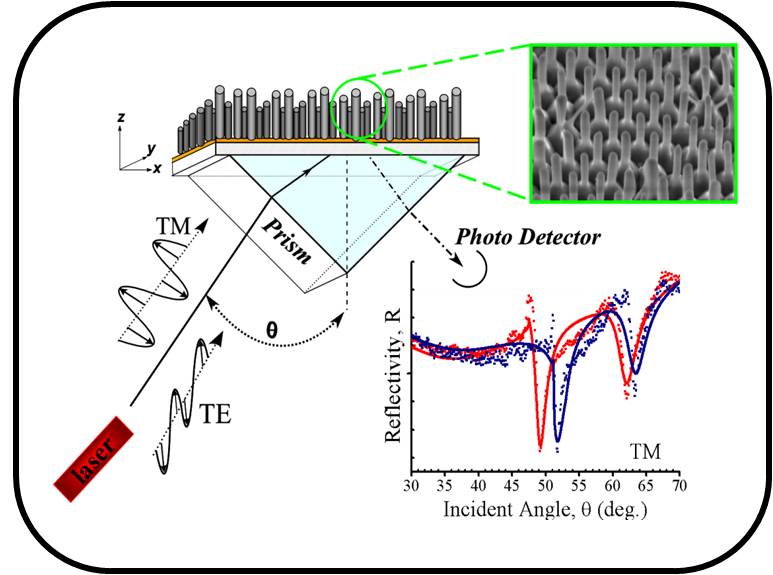
Biosensors are devices that contain biological materials and are used for the qualitative and quantitative detection and monitoring of these materials in various environments. A biosensor consists of three main components: (i) the recognition element; (ii) the transducer, which converts the interaction between the recognizer and the target analyte into an electrical signal; and (iii) the electronic unit. On the sensor surface, an interaction occurs between the “recognizer,” immobilized on the recognition layer of the biosensor, and the “analyte” to be detected. This interaction results in a measurable change—for example, an electrochemical alteration. Alternatively, heat release or absorption may occur, optical properties may change, or a mass variation may be observed. The transducer unit detects this change and converts it into an electrical signal, which is then processed by the electronic unit and transformed into numerically readable data. Surface Plasmon Resonance (SPR) biosensors are a type of optical transducer-based biosensor that detect optical changes occurring on the sensor surface. In the biosensor system we have developed (Nano Letters, 2010), functional polymeric nanorod arrays act as waveguides and provide results that are 7.5 times more sensitive than those obtained with conventional biosensors. Our future objective is to enhance not only the sensitivity but also the selectivity of our nanorod-based sensor platform while simultaneously reducing its production cost.
Related Projects:
“Design and Fabrication of Molecularly Imprinted Polymeric Nanorod Arrays for Integrated Electromechanical-Optical Bioscanner Applications,” TÜBİTAK 1001, 2013–2016.
“Effect of Hard-Confinement on Soft Matter,” Max-Planck Society Partner Group Grant, 2013–2016.
- Doç. Dr. Hatice Duran Durmuş
- KİM 101: Genel Kimya
- MBN 304: Nanomalzemeler ve Üretim Metotları
- MBN 413: Yüzeyler ve Arayüzeyler
- MBN 461: Polimerlerin Fiziksel Kimyasi
Molecular Modeling Methods in Drug Design

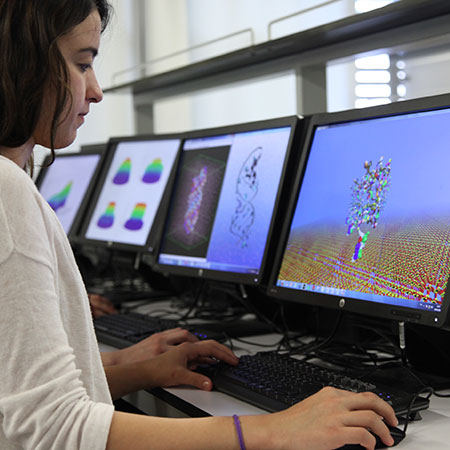
Ion channels enable the transmission of electrical signals in nerve and muscle cells. Malfunction of ion channels due to environmental or genetic factors is the source of many diseases. Therefore, understanding the mechanisms of ion channels at the molecular level is one of the most important problems in neurology, physiology, and pharmaceutical sciences. Nature provides a rich library of toxins that are effective, selective, and fulfill specific requirements for ion channels. Combining laboratory studies with computer simulations enhances the drug-design process. With the advancement of high-performance computing in terms of capacity and speed, it has become possible to accurately analyze molecular-level simulations of proteins and their interactions with ligands. By harnessing this computational power to study the binding of toxins to channels, transporters, and receptors, the goal is to develop new drugs derived from toxin peptides.
- MBN 508: Kuantum Mekanik
- MBN 509: Klasik Mekanik
- MBN 511: Atom ve Molekül Fiiziği
- MBN 520: Biyofizik
- MBN 521: Bio ve Nanoteknolojide Bilgisayar Modellemesi
- MBN 523: Biyoinformatik
Desalination

Fresh water resources are essential for all life and human activities, and they are a prerequisite for sustainable development. Although 70% of the Earth's surface is covered with water, only 0.7% of it consists of drinkable fresh water. Desalination refers to the process of removing salt, minerals, and other impurities from water in order to obtain water suitable for drinking, irrigation, and general use. Countries like ours, surrounded by seas on three sides, are highly suitable for implementing desalination systems. Through desalination, the negative effects of the decrease in fresh water sources—caused by seasonal factors or global warming—can be eliminated.
Related Projects:
“Preparation and testing of new high-technology ultrafiltration and reverse osmosis membranes for water purification systems,” TÜBİTAK TBAG 108T099, 2008–2010.
- Prof. Dr. Mehmet Sankır
Production of Valuable Chemicals and Liquid Fuels by Catalytic Decomposition of Waste Plastic Materials

Today, the consumption of plastic materials is increasing rapidly, and the waste generated as a result of this consumption causes severe environmental pollution. To overcome this problem and eliminate the disadvantages of disposal and incineration methods, the thermal decomposition of plastics—either without catalysts or in the presence of catalysts—into their monomers, various fuels, and/or chemicals required by the petrochemical industry is considered an alternative solution to the pollution caused by plastic waste. It is aimed to synthesize new-generation catalysts (nanocatalysts) to be used in the reaction medium in order to make this conversion more efficient.